




Domestic Violence and Migraine: What You Need to Know
Has your partner ever said things like this to you?
“You’re lucky I stick around. No one else would put up with you being sick all the time.”
“Wow, you’re a mess. You better get yourself together — I don’t want anyone to see you looking like that.”
“I don’t care if your head hurts. Don’t you dare tell me you’re not in the mood.”
If this sounds familiar, you may be the victim of domestic violence. Domestic violence, or partner abuse, does not always involve physical violence. Rather, it’s a pattern of behavior used to gain or maintain power and control over an intimate partner.
Having migraine can make you vulnerable to domestic violence
People with chronic illnesses, such as migraine, often depend on their partners to help them with daily life. Abusive partners use that as leverage. They may claim that you “owe them” for taking care of you, and force you to do things you don’t want to do. They may withhold the care or support you need in order to punish you or make you realize your dependence. They may belittle you or make fun of your illness. And they may blame you for their own behavior. For instance: “It’s your fault I had the affair! What else was I supposed to do? Every time I wanted sex, you were sick in bed with a migraine attack.”
Domestic violence can cause and/or trigger migraine
We know that when someone experiences childhood trauma, they have a higher chance of developing a headache disorder. More specifically, one study found that experiencing violence in childhood increases the odds of having migraine.
“We found the more types of violence the individual had been exposed to during their childhood, the greater the odds of migraine. For those who reported all three types of adversities — parental domestic violence, childhood physical and sexual abuse — the odds of migraine were a little over three times higher for men and just under three times higher for women,” said Sarah Brennenstuhl, PhD, first author of the study.
Did you know that stress is the number-one most common migraine trigger? When you’re in an abusive relationship, the continual stress can make your migraine worse or give you more frequent attacks.
Even after you’ve escaped an abuser, post-traumatic stress can contribute to migraine. PTSD occurs as a result of past trauma — such as partner violence — that caused feelings of terror and helplessness. PTSD is much more common in people with migraine, compared to the general public. Experts don’t think PTSD causes migraine on its own, but it can make migraine symptoms worse.




In a relationship, conflict is not the same as abuse
Living with migraine can make relationships difficult — both for the person with migraine and for their partner. One large study of more than 4,000 people with episodic and chronic migraine and their partners found that more than half of those couples experienced these common problems:
- Migraine disrupting their one-on-one time
- Migraine reducing enjoyment of time spent with your spouse
- Migraine causing one spouse to take over the migraineur’s share of housework
The couples also said they had problems with communication and trust. Nearly 30% of people with migraine said their spouse didn’t really believe what they said about their migraine pain. Even worse: 14% of migraineurs said their spouse got angry or upset at them for having headaches. This number went up to 27.5% for people with chronic migraine.
So what does this mean? How do you know if your partner is abusive, or if migraine is just putting a strain on your relationship?
It can help take a critical look at how your partner handles conflict and stress. When your partner has to wash all the dishes again because you’re sick, are they a little grumpy — or do they explode? When you try to have a conversation about how migraine affects your life, does your partner take you seriously — or do they accuse you of lying? When you’re in the middle of a migraine attack, does your partner take care of you? Or do they act annoyed or angry?
Every relationship has challenges. In a healthy relationship, both partners act in good faith to try to resolve them.
Know the relationship red flags for people with migraine
Here are some warning signs that could mean you’re in an abusive relationship, as well as ways these might play out when you live with migraine.
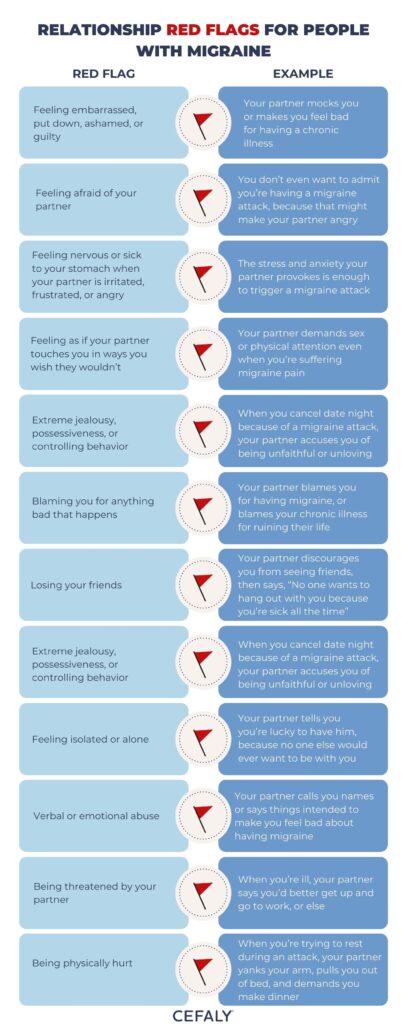
This is not a complete list of red flags! Anything your partner does that makes you feel sad, bad, alone or unworthy can be a sign of abuse.
Domestic violence and abuse is never OK
There is no typical profile of an abuser. An abusive partner isn’t always loud, angry and violent. Some use the silent treatment, cruel words, gaslighting (undermining and twisting your view of reality) and other manipulative tactics to control you. Survivors of partner violence and domestic abuse often say, “They’re so loving and sweet 90% of the time…” to defend their partner’s behavior. But 10% abuse is too much. 1% abuse is too much.
If you’re in an abusive relationship, you deserve better — and help is available. In the U.S., your first step is contacting the National Domestic Violence Hotline. Call 1-800-799-7233 or text START to 88788. Counselors are available 24/7 to offer you free advice and support.
In Canada, reach out to your provincial domestic violence helpline. In Europe, call the helpline for your country.
CEFALY stands with survivors of domestic violence. Take heart, stay strong, and know that things can get better.

Manage your migraine: learn about our drug-free migraine treatment option
Managing migraine attacks can be challenging when you have to balance different medications. Professional support and positive habits can help you manage hormonal triggers. Over time, you can reduce how often you have migraine. When migraine attacks do hit, you can rely on CEFALY. This innovative product can reduce the frequency of attacks and help you manage hormonal triggers.
CEFALY is a wearable device that stimulates the trigeminal nerve that you can use for relief during migraine attacks. With daily use, CEFALY also aids in long-term prevention. Discover CEFALY, buy your wearable device and transform your migraine management today!




Latest Posts


“CEFALY Gave Me My Life Back”: Camille’s Search for a Drug-Free Migraine Treatment
Discouraged by her experience with medications, Camille began building a toolkit of non-pharmacologic migraine treatments. Find out what…

What Patients Need to Know About Episodic Migraine vs. Chronic Migraine
While official definitions classify episodic migraine as fewer than 15 headache days per month and chronic migraine as…